
Court Calendar helps anyone looking for upcoming hearings find exact dates, courtroom locations, and presiding judges without endless scrolling. By typing a case number or party name you can pull a hearing schedule, see the hearing type, and check calendar status codes instantly, matching the intent of lawyers, litigants, and the public. The interface pulls from official court docket data, so you get reliable court date lookup and real‑time updates on rescheduled sessions.
Court Calendar also supports remote access, offering virtual hearing links and clear rules for in‑person attendance when a case is continued. Users can filter by judge, hearing type, or docket to see a concise hearing calendar that reflects the latest court schedule updates. This streamlined search court hearings feature reduces uncertainty, lets you verify a new court date quickly, and keeps you informed about any confidential or sealed hearings that may affect your case.
How to Search Court Calendar
A court calendar lists scheduled court events, including hearings, trials, conferences, and sentencings. A court calendar search can narrow these records by case number, party name, date, judge, or hearing type. Records and updated case history are frequently consulted when verifying active county cases. The official link below is the New Mexico Courts starting point for Bernalillo County District Court, also called the Second Judicial District. A calendar result is a scheduling record, so confirm an important date against the latest notice or court order.
Official Search Portal: https://seconddistrict.nmcourts.gov/location-hours-contacts/
Steps to Search
- Open the official New Mexico Courts website.
- Select Bernalillo County District Court or the Second Judicial District.
- Enter the case number or party’s full legal name.
- Apply date, judge, or hearing filters if available.
- Check the hearing date, time, courtroom, and case status.
- Compare results with the latest court notice or order.
- Contact the court clerk if details are missing or incorrect.
Search Methods by Case, Name, Judge, and Date
Use the search field that matches the record you already have. A case number points to one court file, a party name can lead to several files, and a date or judge filter helps sort a busy docket. The table below shows the best search choice for common court calendar tasks.
For a court schedule by judge, begin with one day and one courtroom. A wider search may place routine matters beside trials, motions, and conferences that have different preparation needs. For a hearing schedule by case number, use the same result to check every listed event, since one case may have more than one future hearing.
Court Calendar or Case Docket
A court calendar is organized around when events occur. A case docket is organized around what happened in a case. Some case-search systems show both and use different labels, so read the event title before choosing a date. Use the docket to review filings and the calendar to plan around a listed hearing. A search court hearings result may also include events that are no longer current. A marked or struck-through entry can remain visible for record history. Look for a later entry, a replacement date, or a current-status label before treating the event as planned.
Read Each Result Before Relying on It
The best source is the one that most closely matches the court’s latest action. Older notes can become outdated after a continuance, settlement, withdrawal, or order. The following order helps separate a confirmed hearing from an outdated listing. Use the latest signed court order or hearing notice first, followed by the current official case entry and court calendar. Personal notes or old messages should only be used for comparison, as they may not reflect recent changes.
Court Schedule Information
A court schedule record gives the practical details needed to prepare for an appearance. The exact fields depend on the source, and some results contain only a case number and hearing type. Reading each available field prevents a correct date from being paired with the wrong courtroom, judge, or event.
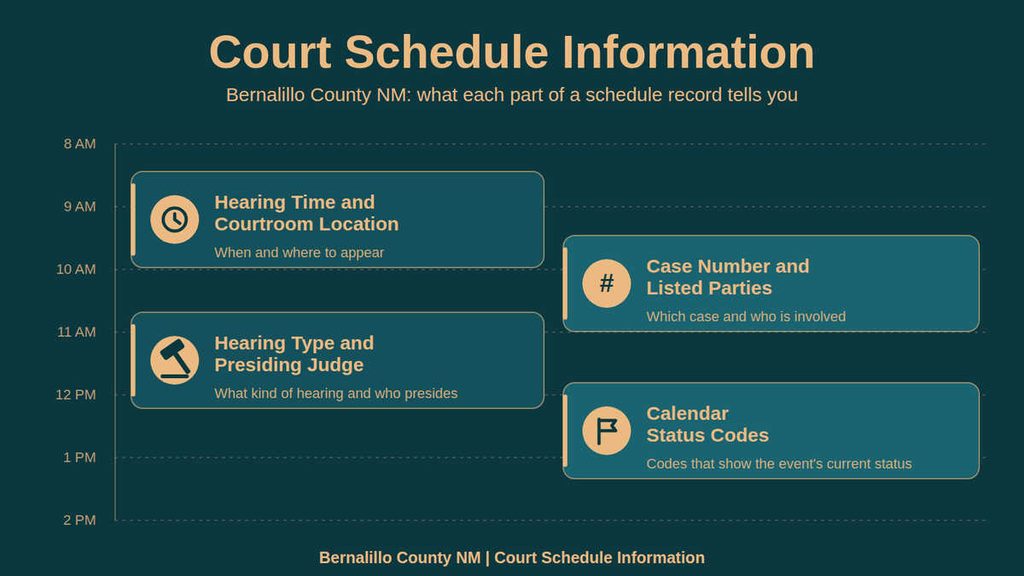
Hearing Time and Courtroom Location
Start with the full event date and local start time. A listed time marks the planned beginning, not a promise that the hearing will end at a certain hour. Courtroom assignments can change, so read a later notice when the court issues one. The hearing date and start time show when the court event is scheduled. Check the latest notice for the courtroom, building address, and any estimated duration, as these details may change. If a field is marked “TBD,” it means the detail has not yet been decided.
What a Courtroom Change Means for Your Appearance
A courtroom is tied to a particular date, judge, and event. A different room for a later hearing does not affect an earlier hearing, and a room listed for one case may not be used for another. If a notice names a courtroom that conflicts with the calendar, ask the court which direction controls before the hearing day.
Case Number and Listed Parties
The case number is the strongest link between a calendar entry and a court file. Party names help confirm that link, but similar names can occur in more than one case. Read the full caption, which may name plaintiffs and defendants, petitioners and respondents, or another pair of parties.
- Copy the complete case number rather than only its final digits.
- Compare each party’s surname with the court papers.
- Check the case type shown in the result, such as civil, criminal, or family.
- Note the county and court division if those fields appear.
- Review related-case entries when the source lists them, since a filing may have moved to a new case number.
If a name search returns no result, try the exact spelling used on the case caption. Search tools may ignore spacing or punctuation, yet they can still depend on the full legal name. A case-number search avoids most of these name problems.
Hearing Type and Presiding Judge
The hearing type tells you what the court plans to address. A status conference, motion hearing, trial, and sentencing each require different preparation. The presiding judge identifies the judicial officer assigned to the listed event, though a later order may change that assignment. Use the event title together with the judge’s name. The title provides the legal purpose of the hearing, while the judge field helps match it to notices and courtroom signs. If the source shows only a short label, open the full event for any explanatory text before making plans.
Calendar Status Codes
Calendar status codes are short values attached to a docket event. Some codes show that an event remains listed, while others mark a change or withhold public case details. The official location-and-contacts page does not supply a code key, so no New Mexico code should be assigned a meaning based on appearance alone. Read the full event, the source’s own legend, and the most recent order together. If the code remains unclear, copy the exact code and event title to the court clerk. That gives court staff enough detail to identify the source entry.
Types of Court Hearings
Court calendars group events by docket, case type, or event name. The label used by one court may differ from the label used by another. The descriptions below explain common hearing purposes without replacing the event title shown for a particular case.
Civil, Criminal, and Family Dockets
The docket category gives basic context for a case. Civil cases usually involve claims between private parties, criminal cases involve charges brought by the government, and family cases involve matters such as marriage, divorce, child support, custody, or protective orders. One case can also have related proceedings listed in another section.
A court may call a family matter a domestic relations docket or place it under a narrower category. A party’s search should use the case number, since a docket label can differ even when the case remains the same.
Arraignments and Pretrial Hearings
Criminal court calendars often list two early events: an arraignment and a pretrial hearing. These events serve different purposes, so their dates should not be treated as interchangeable.
Arraignment
An arraignment is a criminal hearing connected with the formal charge and the defendant’s response to it. The court may address the charge, the defendant’s plea, or the next stage of the case, depending on the charges and the applicable procedure. The calendar entry confirms the scheduled event, not the legal outcome of the hearing.
Pretrial Hearing
A pretrial hearing lets the court and parties prepare for the next case event. Work may include a plea, the exchange of evidence, motions, witness plans, or a proposed trial date. A pretrial conference may settle parts of a case or set a trial, so the event title and the current case record both matter.
Motions, Trials, and Sentencings
These labels describe different stages or requests. A motion asks the court for an order, a trial decides disputed issues after evidence is presented, and a sentencing hearing concerns the sentence in a criminal case. Read the caption carefully because similar words can appear in different dockets.
Motion Hearing
A motion asks the judge to decide an issue or grant a requested action. The court may set a hearing, decide the matter without one, or place it on a written-motion calendar. A motion hearing on the calendar means the matter is listed; it does not show what ruling the judge will make.
Trial
A trial is a higher court event in which evidence and legal arguments decide claims or criminal charges. Civil, family, and criminal trials differ in the issues and procedures they cover. A trial listing can include a jury setting, a bench trial, or a related status event, so the event title controls.
Sentencing
A sentencing hearing follows a criminal conviction or plea in cases where sentencing remains to occur. The judge sets the sentence under applicable law after the required submissions and arguments. A calendar record does not reveal the sentence, the amount of time ordered, or the terms of supervision.
Schedule Changes and Remote Appearances
A hearing can move because of a continuance, a request from a party, a courtroom change, a new order, or a judge’s schedule. Checking official case public information provides direct confirmation when evaluating public records. A current court calendar should reflect recorded changes, yet an entry can remain visible for a short period before the source changes. Check the latest case-specific record whenever a date matters.
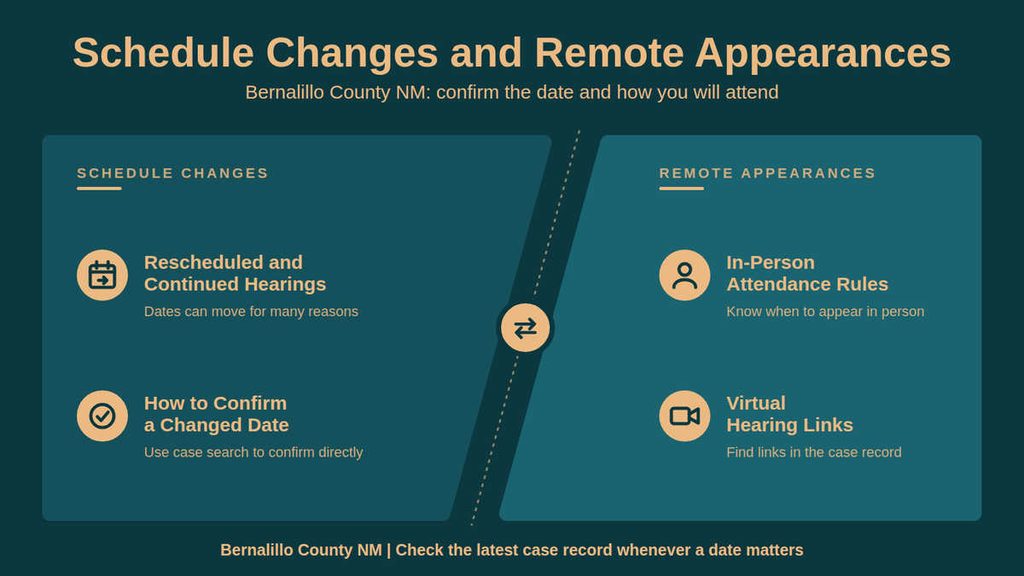
Rescheduled and Continued Hearings
A continued hearing has moved from its earlier date to a later date. The old date normally does not control once the court records the change. A rescheduled hearing may receive a new date, time, courtroom, or event type, so compare each field rather than copying only the new calendar date.
A vacated hearing is different from a continued hearing. Vacated means the listed event will not occur as shown, while a continuance normally points to another event. If no replacement date appears, request the current status from the court rather than assuming that the matter was dismissed or resolved.
How to Confirm a Changed Date
- Place the old notice and the current calendar entry beside each other.
- Compare the event title, case number, hearing type, and judge.
- Read the status field for wording such as continued, vacated, or a new event date.
- Check whether a later order or notice gives a different time or courtroom.
- Ask the court clerk to resolve any conflict that remains after those checks.
After confirmation, update any written appearance plan and remove the old date from personal reminders. Keeping both dates can lead to a wasted trip or missed deadline, especially when a continued hearing has a new judge or event type.
In-Person Attendance Rules
Anyone listed for an in-person hearing should follow the instructions in the current notice. A calendar entry identifies a planned event, but it may not state every requirement for entering the courthouse, checking in, or speaking with court staff. A party who misses a hearing should contact the court as soon as possible. The clerk can explain the recorded event and the procedure for addressing the absence. A calendar entry does not excuse a missed appearance or guarantee that a continuance will be granted.
Virtual Hearing Links
A virtual hearing link may appear in a calendar entry, a case notice, an email, or a court order. The presence of a public calendar listing does not by itself mean that the public may attend. Some remote events are closed, and some links require case-specific sign-in details.
Test the connection before the start time and keep the court’s contact details available. If a link fails, send the case number and event details through the court’s stated contact method. A calendar page cannot repair a failed link or confirm a case-specific sign-in request.
Schedule Accuracy and Resolution
Calendar records can differ from a case file for a short time, especially after a clerk enters a new order. Protected cases may also leave fewer public details. A clear process helps separate a true missing entry from a search error, delayed update, or intentionally limited listing.
Calendar Update Delays
The official court details provided here do not state a fixed posting time for daily calendars. Do not assume that every entry changes at a particular hour. A calendar can lag after a hearing, continuance, order, or clerk’s correction, so a recently changed case deserves a direct check with the court. For recurring calendar checks, compare the same case number and event title each time. This makes a changed status easier to spot than scanning a list of unrelated cases. It also prevents a former hearing date from being mistaken for a current one.
Confidential and Sealed Hearings
Courts may use “confidential” and “sealed” for different protections. The exact legal effect depends on the court order, the type of case, and the court’s rules. A public calendar may show only initials, a sealed label, redacted party names, a limited event title, or no event at all. A missing public entry does not prove that no hearing exists. It may mean the matter is restricted, the event is under a different case number, or the source has not posted it. Check the written notice for that case before drawing a conclusion.
A clerk can confirm whether a listed appearance exists and explain the procedure that applies to that particular matter. Do not ask a judge’s office to disclose a protected matter when the court clerk can check the schedule. Court staff can direct the question to the correct process without placing protected details in an open calendar entry. For a sealed case, rely on case-specific papers and official instructions rather than public search results.
Missing Schedule Resolution
When an expected hearing is missing, work through the search from the most exact field to the least exact. This sequence reduces the chance that a filter, name spelling, or date range caused the problem.
- Repeat the search with the complete case number copied from the latest papers.
- Check for a new case number if the source lists related matters or shows a transfer.
- Search the party’s exact legal name and remove any name filter that was not required.
- Widen the date range by several weeks and search a broader period around the expected date.
- Remove the judge, courtroom, and hearing-type filters one at a time.
- Compare the latest notice, order, and message from the court for a changed date or event type.
- Contact the court clerk and give the case number, party name, known date range, and hearing type.
- Ask whether an unlisted appearance exists, whether it is protected, and which current case entry contains the schedule.
Only the court or a signed order can confirm an unlisted court appearance. A search result, calendar entry, or old notice cannot create a hearing or change a judge’s order. If the clerk confirms a different date, request the current case entry and record the clerk’s confirmation method for future checks.
Contact Information
The New Mexico Courts listing identifies the following contact details for Bernalillo County District Court, also called the Second Judicial District. For questions about court schedules, hearing locations, or case information, contact the Second Judicial District Court directly. Call during regular office hours to confirm current details before visiting. Check the official New Mexico Courts website for updated contact information and court notices.
Frequently Asked Questions
The court calendar shows upcoming court dates, hearings, and trial sessions for the Bernalillo County District Court. Checking the schedule helps parties avoid missed appointments and lets attorneys plan case strategy. The official New Mexico Courts site offers a searchable docket where you can filter by case number, judge, or date. Keep the calendar handy to confirm any changes posted by the clerk’s office.
How can I search the court calendar by case number?
Visit the Second District website and click the “Court Calendar” link. Enter the case number in the search box, then press Find. The system returns a list of all hearings, motions, and trial dates linked to that case. Review each entry for time, courtroom, and judge details. Write the information down or print the page for reference. Verify the date against any recent notice from the court clerk.
Where do I find the court calendar for a specific judge?
Open the official court calendar page and select the “Judge” filter. Choose the judge’s name from the drop‑down menu and click Search. The results display every scheduled hearing, conference, and sentencing assigned to that judge. Use this view to track when a judge will be in session or to plan a filing around their availability. Bookmark the page for quick updates.
Can I look up upcoming court dates using a party’s name?
Yes. On the calendar search form, type the party’s full or partial name in the “Name” field. The system matches the name to any active case and lists related hearings. Check the column labeled “Date” to see when each event occurs. If several matches appear, narrow the list by adding the case type or courtroom number. Always confirm the final date with the clerk’s office.
What steps should I take if a hearing date changes?
First, revisit the court calendar online and locate the original entry. Note the new date, time, and courtroom shown in the updated record. Next, call the clerk at (505)-841-7554 to verify the change and ask if any additional paperwork is required. Finally, inform your attorney or the opposing party promptly to avoid missed appearances. Keep a copy of the updated notice for your records.
How do I find the hearing schedule for a specific date range?
Go to the court calendar page and select the “Date” filter. Choose “From” and “To” fields to set the desired range, then click Search. The results list every hearing, trial, and conference scheduled within those days. Use the sort function to arrange entries by time or courtroom. This view helps you plan visits to the courthouse or prepare for multiple cases on the same day. Remember to refresh the page daily for any last‑minute adjustments.